Whisky Cask Investment Risks: What Buyers Often Miss
I've worked in the whisky cask market for more than five years, and one thing I've learned is that a cask can look fantastic on paper while still being a poor purchase.
A buyer might see a well-known distillery, an attractive age statement, healthy litres remaining and ambitious projected returns. None of those things automatically make it a good deal.
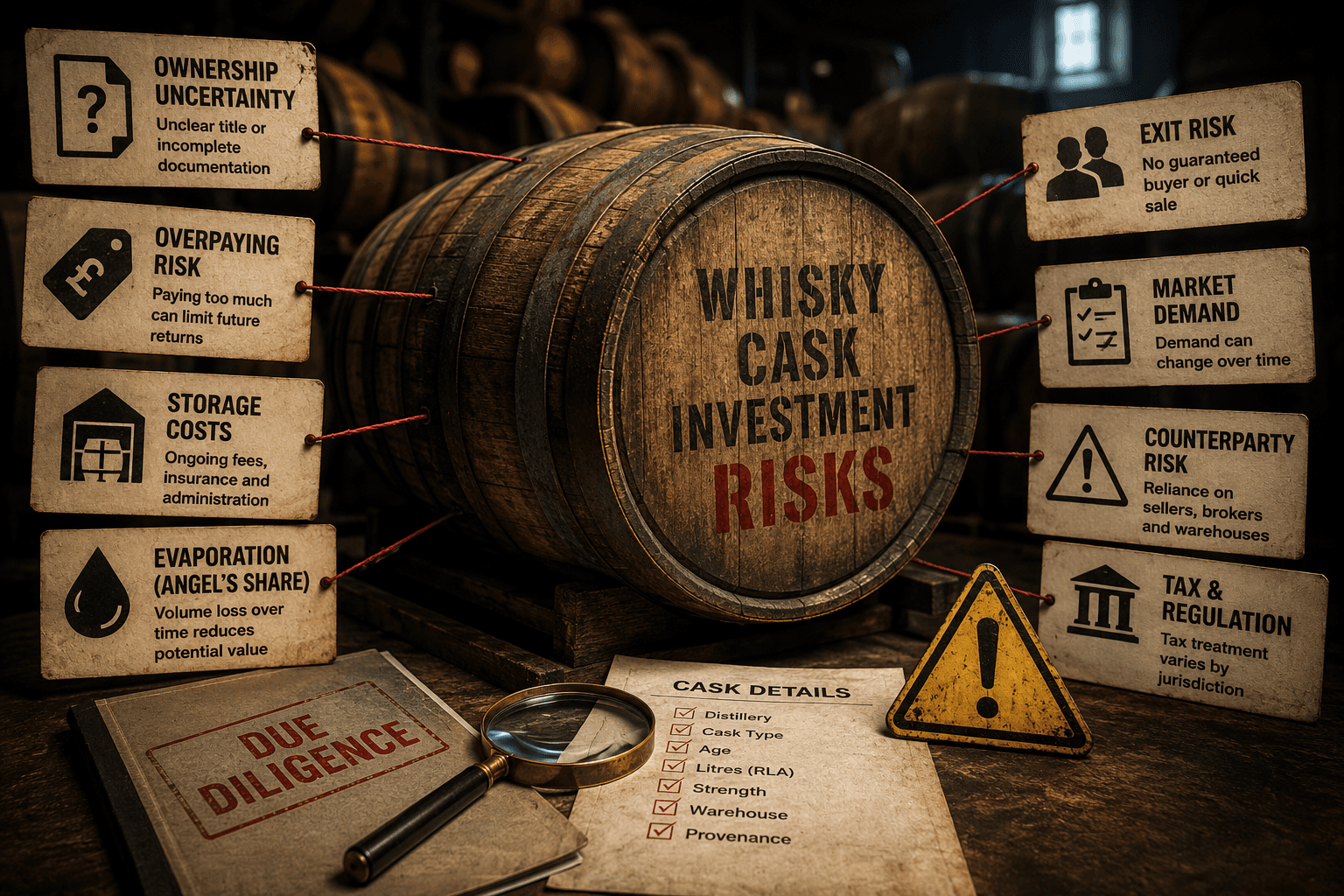
That is the reality of whisky cask investment risks. The asset itself may be genuine and valuable, but that doesn't mean the purchase price is right, the documentation is complete, or the cask will be easy to sell later.
Most problems don't start years after purchase. They start before the money is sent.
Why buyers underestimate risk
Whisky casks sit somewhere between a collectable, a private asset and a tangible commodity. That creates opportunity, but it also creates complexity.
One of the most common mistakes I see is buyers assuming that understanding whisky automatically means understanding casks as assets. It doesn't.
Two casks from the same distillery and vintage can have very different values depending on fill details, cask type, alcohol strength, warehouse location, documentation and market demand.
Unlike shares or ETFs, there is no daily market price and no instant exit. You're buying a specialist asset that may take time to sell and whose value is influenced by multiple factors.
Ownership and provenance come first
Before discussing growth potential, buyers should establish one simple fact: does the seller have the right to sell the cask?
A proper transaction should include clear information on the cask, its location, regauged volume, alcohol strength where relevant, warehouse records and ownership history.
This is one of the biggest risks in the market. Buyers are sometimes shown attractive marketing material without seeing the paperwork that supports ownership.
If you cannot clearly establish who owns the cask, where it is stored and how title is transferred, everything else becomes secondary.
Good documentation doesn't just protect the purchase. It makes the cask easier to sell later.
Overpaying is a bigger risk than many realise
Not every bad deal is a scam.
In fact, many genuine casks are simply overpriced.
I've seen buyers focus heavily on avoiding fraud while paying far too much at entry. Even if the cask is authentic and professionally stored, overpaying can make a future sale difficult.
Pricing is influenced by age, distillery reputation, cask type, litres remaining, alcohol strength and demand from bottlers and private buyers. None of those factors move in a straight line.
Projected returns should always be treated as estimates, not outcomes. They rely on assumptions about future demand, maturation and timing. If those assumptions are already built into today's price, your margin for error becomes much smaller.
Storage and maturation aren't free
Owning a cask comes with ongoing costs.
Storage charges, insurance, administration fees and periodic regauging can all affect your overall return.
Then there is the angel's share.
As whisky matures, volume naturally decreases. In many cases the increase in age and rarity offsets that loss. In others, especially where the entry price was high, the economics can become less attractive.
This doesn't make cask ownership a bad idea. It simply means buyers should understand the realities of ownership rather than assuming they can buy, wait and automatically profit.
The biggest question: who buys it from you?
In my experience, the most overlooked risk is exit risk.
Many buyers spend significant time researching how to buy a cask but very little time thinking about how they will eventually sell it.
The question isn't simply what the cask might be worth in ten years. The question is who is likely to buy it.
Potential buyers may include private collectors, brokers, independent bottlers or trade participants. Each group values casks differently.
A cask can be high quality and still prove difficult to sell if the paperwork is weak, the pricing is unrealistic or the stock isn't particularly attractive to the next buyer.
Whenever I'm assessing a cask, I don't just ask whether I'd buy it today. I ask whether someone else would want it in five years' time.
~
Process matters more than people think
A whisky cask transaction involves much more than sending funds and receiving a certificate.
There are warehouse transfers, title changes, invoices, account references and ownership confirmations to coordinate.
Counterparty risk doesn't always mean dishonesty. Sometimes it simply means poor administration, weak record keeping or lack of experience.
A good process should include verification before payment, documented transfer procedures and confirmation from the bonded warehouse where appropriate.
Those steps protect both the purchase and the eventual resale.~
Tax and suitability
A whisky cask is not a regulated savings product and should not be treated as one.
Returns are not guaranteed, valuations are not standardized and liquidity is limited compared with traditional investments.
Tax treatment depends on personal circumstances and jurisdiction, so buyers should always seek professional advice before making significant purchases.~
How to reduce risk before buying
The strongest buyers tend to be methodical rather than speculative.
They review documentation, verify ownership, understand ongoing costs and challenge pricing where necessary.
Questions worth asking include:
- Why is the cask being sold?
- What fees apply during ownership?
- How is title transferred?
- What evidence supports the asking price?
- What type of buyer is most likely to purchase this cask later?~
If the answers are vague, confidence should drop accordingly.
At Cask Empire, our role isn't to eliminate risk entirely. No credible company can do that. Our job is to reduce unnecessary risk through verification, pricing guidance, ownership transfer management and clearer resale pathways.
After more than five years in the industry, I've found that the best buyers aren't necessarily the biggest whisky enthusiasts. They're the most disciplined. They verify ownership, understand the costs, think about resale before they think about returns and treat every cask as an individual asset rather than a romantic idea.
That's usually where the best decisions begin.