Which Scotch whisky distilleries offer the most attractive opportunities for private cask buyers?
Scotland is home to more than 150 operational whisky distilleries, producing millions of litres of spirit annually. Yet when it comes to purchasing whisky casks, not all distilleries offer the same opportunities.
Some command significant premiums because of their international reputation. Others attract buyers through scarcity, maturation potential or comparatively affordable entry prices.
For prospective buyers, understanding the difference between brand recognition, cask quality, purchase price and resale demand is essential.
At Cask Empire, we've identified five distilleries worth considering in 2027.
Our selection considers reputation, market positioning, relative scarcity and the potential appeal of mature casks to future buyers.
1. Macallan: The Luxury Benchmark
Region: Speyside
Best suited for: High-budget collectors and experienced cask buyers
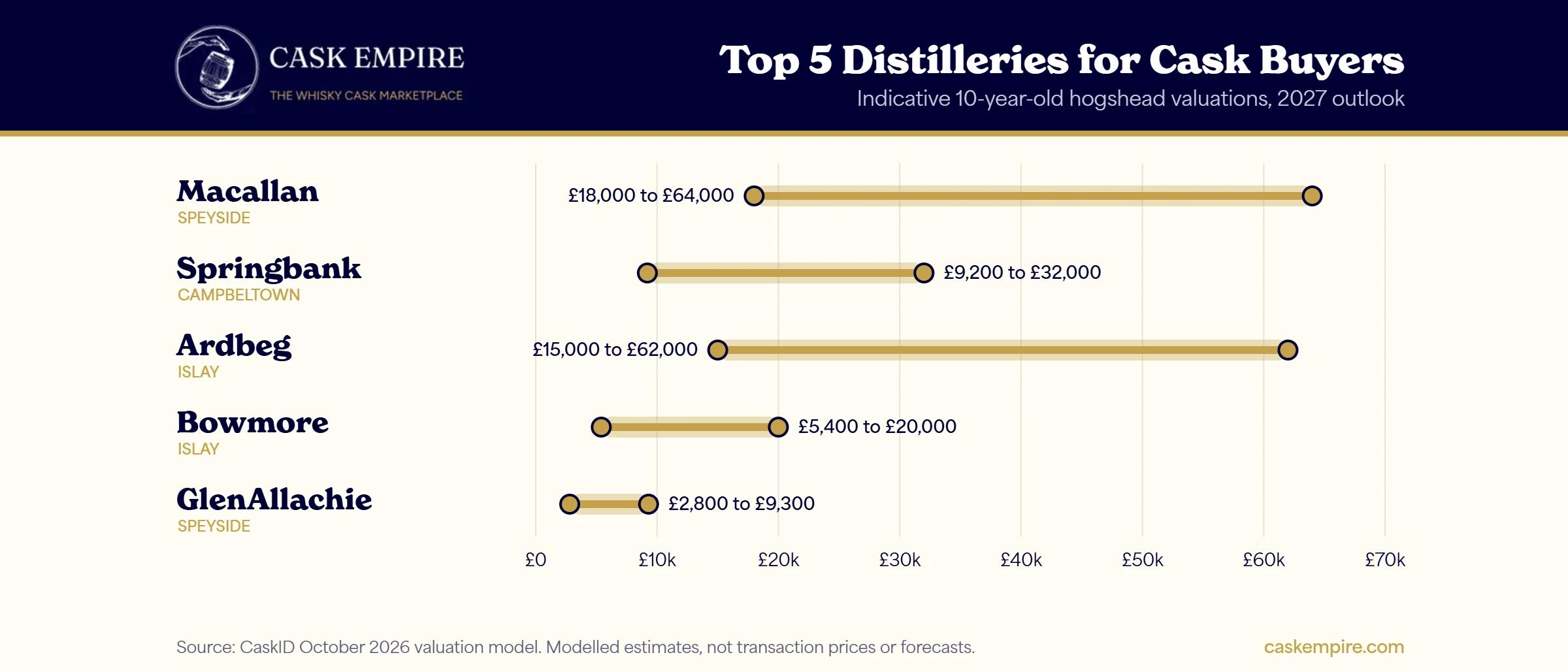
Indicative 10-year-old cask value: £18,000 to £64,000
Few names in Scotch whisky carry the international recognition of Macallan.
The Speyside distillery has established itself as one of the most prominent luxury whisky brands, particularly through its older expressions and high-profile collectible releases.
However, that reputation comes at a price.
According to CaskID's October 2026 valuation model, ten-year-old Macallan hogsheads carry indicative values ranging from £18,000 to £50,000 for ex-bourbon maturation and £24,000 to £64,000 for ex-sherry.
These are modelled estimates rather than confirmed transaction prices.
Why consider Macallan?
- International brand recognition.
- Established market for premium and collectible bottled whisky.
- Potential appeal to specialist independent bottlers.
- Scarcity of privately available casks relative to wider market interest.
Our assessment: Macallan is a premium option, but investors must avoid assuming that an expensive entry price automatically delivers superior returns.
Purchasers should also verify applicable brand-name and bottling restrictions, which may materially affect the available exit options.
2. Springbank: Scarcity and Collector Appeal
Region: Campbeltown
Best suited for: Buyers prioritising rarity and limited supply
Indicative 10-year-old cask value: £9,200 to £32,000
Springbank occupies a distinctive position within the Scotch whisky industry.
Its relatively small-scale production and longstanding reputation among whisky enthusiasts have helped establish a strong collector following.
Unlike larger distilleries producing millions of litres annually, Springbank operates on a considerably smaller scale.
This makes privately available casks particularly interesting, although limited supply can also make purchasing difficult.
Why consider Springbank?
- Limited production compared with major Scotch whisky producers.
- Strong recognition among enthusiasts and independent bottlers.
- Established reputation for traditional production methods.
- Potential scarcity premiums for particular vintages and cask types.
Our assessment: Springbank is an attractive name to investigate for long-term ownership, but scarcity alone does not guarantee a profitable exit.
A buyer must carefully consider whether the premium paid today leaves sufficient room for future appreciation.
3. Ardbeg: A Premium Islay Contender
Region: Islay
Best suited for: Buyers seeking established peated single malt
Indicative 10-year-old cask value: £15,000 to £62,000
Ardbeg has built a highly recognisable identity around its distinctive heavily peated spirit.
Its reputation among whisky enthusiasts, together with its premium brand positioning, makes it an interesting distillery for collectors and cask buyers.
Ardbeg casks can command substantial valuations, particularly where age, provenance and cask quality support the asking price.
Why consider Ardbeg?
- International recognition within the peated whisky category.
- Strong brand identity.
- Established appeal among whisky enthusiasts.
- Potential interest from specialist bottlers.
Our assessment: Ardbeg offers exposure to a recognised premium whisky producer, but buyers should pay particular attention to purchase premiums and the limited evidence available on private cask resale prices.
As with Macallan, independent bottling and brand-use permissions must be investigated before purchase.
4. Bowmore: Heritage and Mature Whisky Potential
Region: Islay
Best suited for: Buyers interested in established Islay whisky
Indicative 10-year-old cask value: £5,400 to £20,000
Bowmore is one of Scotland's oldest licensed whisky distilleries, with production dating back to 1779.
Its long history and established portfolio of aged whiskies make it an interesting name for buyers considering longer maturation periods.
Compared with Ardbeg, some Bowmore casks may be available at considerably lower valuations.
However, prices vary substantially depending on age, wood type, alcohol strength and individual cask quality.
Why consider Bowmore?
- Long-established distillery heritage.
- Recognised mature single malt portfolio.
- Exposure to the Islay whisky category.
- Potentially more accessible pricing than certain premium Islay alternatives.
Our assessment: Bowmore deserves consideration from buyers who want an established distillery name without necessarily entering at the very highest premium price levels.
The quality and condition of the individual cask remain central to any purchasing decision.
5. GlenAllachie: An Interesting Value Proposition
Region: Speyside
Best suited for: Buyers seeking a more accessible entry point
Indicative 10-year-old cask value: £2,800 to £9,300
GlenAllachie has developed a stronger independent identity since coming under the ownership of Billy Walker and his partners in 2017.
With growing recognition for its sherry-influenced expressions, the distillery offers an interesting alternative to some of Speyside's more established luxury names.
More importantly, entry prices can be substantially lower than those associated with Macallan.
Why consider GlenAllachie?
- Growing recognition among single malt enthusiasts.
- A distinctive premium whisky identity.
- Relatively accessible indicative cask valuations.
- Potential appeal to independent bottlers.
Our assessment: GlenAllachie is worth researching for buyers seeking a balance between distillery reputation and acquisition cost.
However, buyers should not confuse a lower purchase price with a guaranteed opportunity for future growth.
Whisky Cask Price Comparison: Which Distillery Offers the Best Value?
The following figures provide an indicative comparison of ten-year-old Scotch whisky casks.

- Macallan: £18,000 to £64,000
- Springbank: £9,200 to £32,000
- Ardbeg: £15,000 to £62,000
- Bowmore: £5,400 to £20,000
- GlenAllachie: £2,800 to £9,300
Source: CaskID, October 2026 cask valuation report.
These figures represent modelled valuation ranges for standard ten-year-old hogsheads, not verified current offers or guaranteed resale values.
Actual prices depend on numerous factors, including:
- Distillery and vintage.
- Cask type and previous contents.
- Remaining litres of pure alcohol (RLA).
- Alcohol by volume (ABV).
- Warehouse provenance and ownership documentation.
- Market demand and available exit opportunities.
Does Whisky Become More Valuable as It Ages?
Age is an important factor in Scotch whisky valuation, but it is not the only consideration.
A whisky cask purchased at ten years old may attract a different category of buyer once it reaches 18, 21 or 25 years of maturation.
However, older whisky does not automatically become more valuable.
Evaporation, changes in alcohol strength, warehouse costs and shifts in market demand all influence the eventual financial outcome.
Furthermore, a buyer may pay considerably more for a cask than the underlying trade market would support.
The price you pay at acquisition can be just as important as the distillery you select.
For a detailed explanation, read our guide: How Do Whisky Casks Increase in Value as They Age?
The Whisky Market in 2027: What Should Buyers Consider?
The Scotch whisky industry continues to operate on a significant international scale.
According to the Scotch Whisky Association, exports reached approximately £5.3 billion in 2025, with around 1.3 billion equivalent bottles shipped internationally.
However, export values declined during 2025, reflecting softer consumer demand and difficult trading conditions.
The secondary whisky market has also experienced a price correction.
CaskID's October 2026 research estimated that comparable whisky cask trade prices during 2024 to 2026 were approximately 28% below those recorded during 2020 to 2023.
This creates an important distinction.
While certain buyers may see opportunities in lower valuations, there is no guarantee prices will recover or that individual casks can be resold profitably.
A disciplined acquisition strategy is therefore essential.
Before Buying a Whisky Cask: Five Essential Checks
Regardless of distillery reputation, buyers should establish five things before committing capital.
1. Verify ownership. Ensure the seller has the legal right to sell the cask and that ownership can be properly transferred and acknowledged by the warehousekeeper.
2. Confirm warehouse details. Identify where the cask is stored and verify its documentation, cask number and provenance.
3. Understand the true purchase price. Compare the quoted price against available trade evidence, taking account of age, ABV and remaining RLA.
4. Calculate holding costs. Storage, insurance, sampling, regauging and eventual bottling or transportation may create additional expenses.
5. Establish a realistic exit strategy. Identify potential buyers and understand whether resale restrictions or limited market liquidity could affect the eventual sale.
The Scotch Whisky Association emphasises that there is no regulated, transparent public marketplace for whisky cask transactions.
Prospective purchasers should therefore conduct thorough independent due diligence.
Final Thoughts: Which Whisky Distillery Would We Choose?
There is no single distillery suitable for every whisky cask buyer.
Macallan and Ardbeg may attract buyers seeking internationally established premium brands.
Springbank offers an interesting scarcity proposition.
Bowmore combines heritage with a recognised mature whisky portfolio.
Meanwhile, GlenAllachie provides a potentially more accessible starting point.
At Cask Empire, we believe the most important consideration isn't simply which distillery produces the whisky.
It's whether you're purchasing the right cask, at the right price, with verified ownership and a realistic route to resale.
A well-priced cask from a less fashionable distillery may ultimately represent a more attractive acquisition than an overpriced cask from a globally recognised name.
Looking to Buy or Sell a Whisky Cask?
Cask Empire helps private whisky cask owners understand their assets, explore market valuations and investigate potential resale opportunities.
Whether you're considering your first cask purchase or looking to exit an existing holding, making informed decisions starts with understanding the market.
Explore Cask Empire's whisky cask marketplace or request a cask valuation today.
Disclaimer: This article is provided for general information and does not constitute financial or investment advice. Whisky cask ownership involves risks, including potential capital losses, additional holding costs and limited resale opportunities. Indicative valuations are not guaranteed transaction prices or forecasts of future returns.