The Whisky Regions of Scotland: A Guide to Scotch Whisky
Scotland may be a relatively small country, but its whisky landscape is remarkably diverse. From the powerful, smoky malts of Islay to the elegant whiskies of Speyside, geography has become an important part of how Scotch whisky is understood, marketed and enjoyed around the world.
For anyone buying, collecting or investing in whisky casks, understanding Scotland's whisky regions provides useful context when comparing distilleries, flavour profiles and cask opportunities.
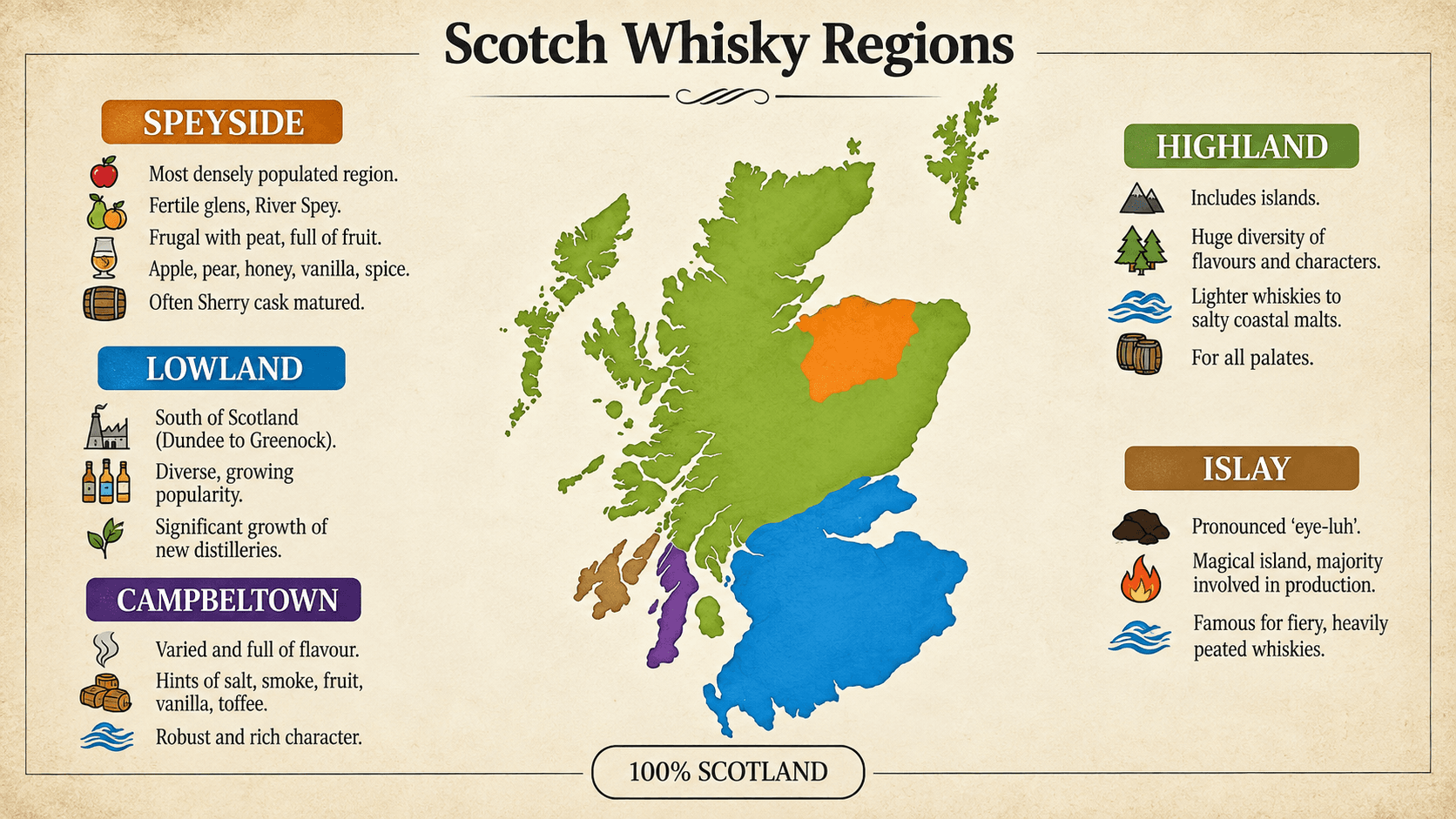
The Five Scotch Whisky Regions
For Scotch whisky purposes, Scotland is traditionally divided into five recognised whisky-producing regions: Highland, Lowland, Speyside, Islay and Campbeltown.
You will also frequently hear about the Islands. Although widely treated as a distinct whisky region by enthusiasts, the Islands technically form part of the Highland region.
1. Speyside
Located around the River Spey in northeast Scotland, Speyside contains an extraordinary concentration of whisky distilleries.
The region is associated with some of the biggest names in Scotch whisky, including The Macallan, Glenfiddich, The Glenlivet, Balvenie and Aberlour.
Speyside whiskies are often characterised by:
- Orchard and dried fruits
- Honey and vanilla
- Rich sherry influence
- Spice and oak
- Generally lower levels of peat and smoke
There is considerable variation within the region, but Speyside has become particularly famous for elegant, fruit-driven single malts and maturation in ex-sherry casks.
From a cask ownership perspective, Speyside is especially interesting because it combines a globally recognised regional identity with a large and diverse distillery base.
2. The Highlands
The Highlands cover the largest geographical whisky region in Scotland, stretching across much of the mainland north of the Highland boundary.
Because the territory is so vast, there isn't really one definitive "Highland style."
Distilleries include Glenmorangie, Dalmore, Oban, Deanston and Glengoyne, among many others.
Depending on the distillery, Highland whisky can range from light and floral to rich, spicy and occasionally heavily peated.
Common characteristics can include:
- Heather and honey
- Malt and cereal
- Fruit
- Oak and spice
- Smoke in certain expressions
This diversity makes Highland whisky particularly interesting. Two casks carrying the same regional designation can produce dramatically different whisky depending on the distillery, spirit character, cask type and maturation environment.
3. Islay
Few whisky-producing locations have developed an identity as distinctive as Islay.
The small island off Scotland's west coast is famous for powerful, heavily peated single malts. Distilleries including Ardbeg, Laphroaig, Lagavulin, Bowmore and Bruichladdich have helped make Islay one of the most recognisable names in Scotch whisky.
Typical flavours associated with Islay include:
- Peat smoke
- Maritime and coastal notes
- Iodine and medicinal characteristics
- Sea salt
- Charred wood
- Citrus and sweetness underneath the smoke
Not every Islay whisky is heavily peated, however. Distilleries and individual releases vary significantly.
For collectors and cask buyers, Islay's advantage is the strength of its identity. Even relatively casual whisky drinkers frequently recognise Islay as synonymous with smoky Scotch.
4. The Lowlands
The Lowlands cover southern Scotland and historically developed a reputation for lighter, more delicate styles of whisky.
Classic Lowland characteristics include:
- Grass and fresh herbs
- Citrus
- Flowers
- Vanilla
- Light cereal sweetness
Well-known Lowland distilleries include Auchentoshan and Glenkinchie, while a new generation of distilleries has brought considerable renewed activity to the region.
Lowland whisky shouldn't simply be thought of as "light Scotch." Modern production techniques, different cask programmes and newer distilleries mean the region is increasingly diverse.
5. Campbeltown
Campbeltown provides one of the most fascinating stories in Scotch whisky.
The small town on the Kintyre peninsula was once one of the world's great whisky-producing centres, with dozens of operating distilleries during its nineteenth-century peak.
Today, production is dramatically smaller, but Campbeltown has developed something of a cult following among whisky enthusiasts.
Its best-known distilleries include Springbank, Glen Scotia and Glengyle, which produces Kilkerran.
Campbeltown whiskies can display:
- Maritime character
- Oiliness
- Brine
- Smoke
- Fruit
- Spice
Its relatively small number of producers also gives Campbeltown a scarcity factor that distinguishes it from much larger regions such as Speyside and the Highlands.
What About the Islands?
You'll regularly see whisky described as coming from the "Islands."
This includes distilleries located on islands such as Skye, Orkney, Arran, Mull and Jura.
Famous examples include Talisker on Skye and Highland Park on Orkney.
However, the Islands are not officially classified as a separate Scotch whisky region and technically sit within the Highland region.
Island whiskies are nevertheless frequently grouped together because of their geography and, in some cases, their maritime character.
There is no universal Island flavour profile. Some are smoky and powerful, while others are fruity, sweet or relatively delicate.
Does Whisky Region Matter When Buying a Cask?
Yes — but it shouldn't be considered in isolation.
Region can provide useful context and significantly influence how a whisky is perceived by consumers. However, when evaluating an individual whisky cask, other factors can be considerably more important.
These include the distillery, age, cask type, original litres of alcohol, current ABV, regauge information, ownership documentation, storage arrangements and potential route to exit.
Two casks from the same region can therefore represent completely different propositions.
A 10-year-old Speyside whisky matured in an ex-bourbon barrel is fundamentally different from a 25-year-old Speyside whisky matured in a first-fill sherry butt.
Region tells you part of the story.
The cask itself tells you the rest.
Scotland's Whisky Regions at a Glance
Speyside
Style: Fruity, elegant and often sherried
Notable distilleries: Macallan, Glenfiddich, Glenlivet
Highlands
Style: Highly varied, ranging from light and fruity to rich and smoky
Notable distilleries: Glenmorangie, Dalmore, Oban
Islay
Style: Peaty, smoky and maritime
Notable distilleries: Ardbeg, Laphroaig, Lagavulin
Lowlands
Style: Light, floral and fresh
Notable distilleries: Auchentoshan, Glenkinchie
Campbeltown
Style: Maritime, oily and complex
Notable distilleries: Springbank, Glen Scotia, Glengyle
The Islands
Style: Highly varied, often with maritime characteristics
Notable distilleries: Talisker, Highland Park
Final Thoughts
Scotland's whisky regions provide a useful map for navigating one of the world's most diverse spirits industries.
But when it comes to whisky casks, region should be the beginning of your research rather than the end of it.
Understanding where a whisky comes from can tell you something about its heritage, reputation and likely character. Understanding the individual cask — its provenance, maturation, condition and ownership — is what allows you to properly evaluate what you're buying.
At Cask Empire, our focus is on bringing greater transparency to whisky cask ownership, helping buyers and owners understand what they hold and the factors that can influence its value over time.
